
Echo Registry Breed Standards

• F1–F3 hybrids are early-generation and may carry legal/ownership restrictions — always verify local laws.
• Photos must clearly show head shape, ear set, coat pattern, body proportions, and size reference (e.g., with a ruler or known object).
• Temperament must be unchallenging (per TICA guidelines).
• All listings must reflect responsible, ethical practices and full health disclosure. By submitting a listing, you confirm your cat meets the appropriate standard above. Our moderation team is here to answer questions and support transparent, ethical listings.
Echo Registry Breed Standards

Thank you for registering with Echo Registry — the responsible registry dedicated to ethical listings of exotic cats, hybrids, litters, and catteries. These standards ensure every listing accurately reflects the animal’s species, generation (for hybrids), appearance, proportions, and quality. All submissions undergo manual review by our team. Photos and descriptions must clearly demonstrate compliance with the appropriate standard. Misrepresentation, poor-quality images, or failure to meet these guidelines will result in rejection or removal of the listing. Accurate generation documentation (pedigree and/or DNA) is required for all hybrids.


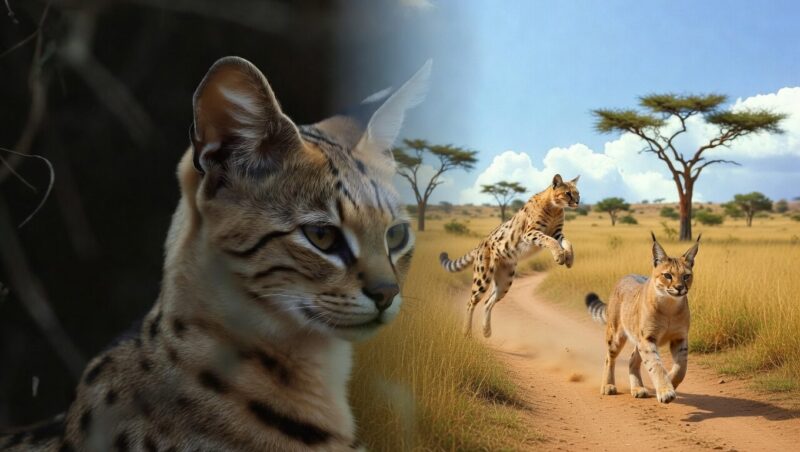
Medium-sized, slender African wild cat built for leaping and hunting in tall grass.
• Shoulder height: 54–62 cm (21–24 in); weight: 9–18 kg (20–40 lb).
• Build: Exceptionally long legs and neck, small head, athletic and graceful.
• Ears: Largest relative to body size of any cat — very tall, rounded, with white ocelli on the back.
• Coat: Golden-yellow to buff with solid black spots and stripes; short black-tipped tail.
• Overall impression: Tall, leggy, elegant hunter.


Medium-sized, powerful wild cat known for agility and speed.
• Shoulder height: 40–50 cm (16–20 in); weight: 8–19 kg (18–42 lb).
• Build: Long legs (hind longer, creating a sloping profile), muscular, short face.
• Ears: Tall with distinctive long black tufts (up to 4.5 cm).
• Coat: Uniform tawny-brown to sandy with white underparts; no spots or stripes. Short bushy tail.
• Overall impression: Robust and elegant with striking ear tufts.


Medium-sized, beautifully patterned wild cat of the Americas.
• Shoulder height: 40–50 cm (16–20 in); weight: 7–18 kg (15–40 lb).
• Build: Compact and muscular.
• Coat: Tawny, grayish or cinnamon background with unique black spots, rosettes, bars, and chain-like markings (every individual’s pattern is distinct). Two black cheek stripes.
• Tail: Medium length with dark rings.
• Overall impression: Strikingly marked wild beauty.


Small, slender wild cat — the foundation for Bengals.
• Weight: 1.7–7 kg (4–15 lb) depending on subspecies; leggier than a domestic cat of similar size.
• Build: Long legs, small head, short narrow muzzle.
• Ears: Rounded with central white spots on the back.
• Coat: Yellowish to grayish with black rosettes or spots; four black forehead stripes; spotted legs and tail.
• Overall impression: Compact, high-contrast wild type.


Stocky, adaptable North American wild cat.
• Shoulder height: 30–60 cm (12–24 in); weight: 4–18 kg (9–40 lb).
• Build: Muscular with prominent facial ruffs.
• Distinctive features: Small black ear tufts, short “bobbed” tail with black tip.
• Coat: Buff to reddish-brown or gray with variable dark spots, bars, and stripes.
• Overall impression: Robust wild bobcat appearance.

Tall, elegant hybrid with Serval-like grace.F1 Savannah (≈50% Serval)
Largest generation. Males often 17–25+ lbs. Strongest wild traits: extremely long legs/neck, largest ears, bold sparse spotting, high energy and drive.F2 Savannah (≈25% Serval)
Still significantly exotic. Prominent long legs, tall ears, striking spotted pattern; slightly more moderate than F1.F3 Savannah (≈12.5% Serval)
Noticeable Serval influence in size, leg length, ear set, and pattern, with improving domestic temperament.F4 and Higher (Advanced Generation Savannah)
Conforms to the official TICA Savannah Breed Standard (updated 05/01/2024):
The Savannah is a tall, lean, graceful cat with striking dark spots and other bold markings on a background color of any shade of brown, silver, black or black smoke. It closely resembles its ancestral source, the African Serval, but is smaller in stature. Exceptionally long neck, legs, and tall ears, plus a medium-length tail. Head forms an equilateral triangle. Ears remarkably large and high on the head. Bold spotted pattern only (round, oval, or elongated spots). Athletic, confident, and outgoing.

Serval cat registration – ECHO Registry

Bengal Cat (Asian Leopard Cat × Domestic Cat)

Athletic, wild-looking hybrid with high-contrast markings.F1 to F3 Foundation Bengals
Higher ALC blood percentage. Larger, more muscular build with stronger wild traits, bolder rosetting/marbling, and more independent temperament.F4 and Higher (SBT Bengal)
Conforms to the official TICA Bengal Breed Group Standard (updated 05/01/2020):
A medium-to-large, sleek, very muscular and solid cat with strength, agility, balance, and grace. Broad modified wedge head with rounded contours. Relatively short rounded ears. Large oval, almost round eyes. Dense, luxurious coat (short to medium) with extreme contrast in spotted, rosetted, marbled, or charcoal patterns. Thick tapered tail. Athletic, alert, curious, and confident.

Ocelot Hybrid

Extremely rare due to chromosomal differences and legal restrictions in many areas. True hybrids are not standardized by any major registry.F1 to F3
Stronger wild influence: larger size, bolder rosetted/chain spotting, and more muscular ocelot-like build.F4 and Higher
More domestic proportions with retained exotic rosetted pattern resembling the wild ocelot.
Note: Many spotted “ocelot-type” cats are actually Ocicats (fully domestic breed with no wild blood).Bobcat Hybrid
True bobcat × domestic hybrids are rare and heavily regulated. The closest recognized breed is the TICA Pixie-bob (developed to resemble the North American bobcat).F1 to F3 Bobcat Hybrid
Stronger wild traits: more pronounced ear tufts, facial ruffs, heavier boning, and bobbed tail.F4 and Higher (Pixie-bob type)
Conforms to the official TICA Pixie-bob Breed Group Standard (revised 05/01/2008):
A domestic cat with visual similarity to the North American Bobcat yet a loving, trusting temperament. Medium-to-large, rangy, muscular build with heavy boning. Inverted-pear head shape, deeply hooded eyes, well-developed fleshy chin, and short bobbed tail (minimum 2 inches). Brown spotted tabby pattern. Distinctive bobcat-like appearance.fident.

Caracat (Caracal × Domestic Cat)

Elegant hybrid blending caracal wildness with domestic traits (TICA experimental status).F1 to F3 Caracat
Larger size (F1 can exceed 10–16 kg). Most pronounced caracal features: prominent long black ear tufts, sandy/tawny coat, long legs, and wild facial markings.F4 and Higher Caracat
More moderate size with reduced ear tufts and proportions closer to domestic cats, while retaining the elegant long-legged build and exotic caracal-like appearance.

Serval cat registration – ECHO Registry

Sign In

Register

Reset Password

Please enter your username or email address, you will receive a link to create a new password via email.